Picture a sales team where reps spend hours on outreach, chasing cold leads, and wrestling with a messy CRM, rather than talking to customers. AI assisted sales blends predictive analytics, lead scoring, sales automation, conversational AI, and personalization to turn busywork into clear signals that guide more innovative prospecting and faster deal progression. This article shows practical steps to effortlessly increase sales efficiency, close more deals, and drive revenue growth by effectively implementing AI-assisted sales strategies in their team.
AI Acquisition's solution, AI automation software, puts those steps into your daily workflow, automating email outreach, improving pipeline management, and surfacing customer insights that help your reps focus on the right conversations and close more deals.
Summary
AI-assisted automation cuts routine admin and raises seller productivity, with Cirrus Insight reporting about a 30% increase in rep productivity when teams adopt AI tools.
Adoption is moving into the mainstream, with industry forecasts projecting that roughly 75% of sales organizations will use AI by 2025, making integration and execution the real differentiators.
Well-executed implementations show direct revenue impact, with some deployments reporting average monthly lifts of around $18,105 per client and broader studies finding about a 30% revenue bump for AI-using teams.
Short, controlled pilots drive behavioral change, for example, a four-week pilot where reps shifted to two focused outreach sessions per day and follow-up cycles compressed from days to hours.
Model maintenance matters; retraining cadence should match signal drift, for example, retrain biweekly if product signals change weekly, or monthly to quarterly when signals are stable.
Measure business KPIs with holdout experiments and guardrails, as studies show AI-driven strategies can cut customer acquisition costs by roughly 50% while improving conversion rates and pipeline velocity.
AI Acquisition's AI automation software addresses this by automating email outreach, improving pipeline management, and surfacing customer insights so reps can focus on the most promising conversations.
Table of Content
What is AI-Assisted Sales?

AI-assisted sales uses machine intelligence to augment your selling muscle. It automates routine work, highlights the highest-value prospects, and personalizes outreach, so your team spends more time closing and less time on busywork. In practice, that means AI handles lead scoring, recommends the following best action, forecasts pipeline health, drafts tailored messages, and keeps your CRM up to date.
What Exactly Is Artificial Intelligence (AI)?
AI is software that finds patterns in data and turns those patterns into predictions or recommendations you can act on. Think of it as statistical intuition compressed into code. It learns from past interactions, customer signals, and outcomes, then suggests what will likely work next.
What is AI-assisted Sales?
AI-assisted sales combines those predictive abilities with sales workflows. It watches signals across email, web behavior, demo activity, and CRM history, then ranks leads, times outreach, drafts personalized content, and scores deal risk. Move the right conversations forward, faster, with fewer mistakes and more relevance.
What Specific Tasks Will AI Actually Do for My Team?
Prioritize leads and accounts with predictive lead scoring and intent signals.
Personalize outreach at scale with recommended talking points and content.
Forecast revenue and identify at-risk deals with pipeline analytics.
Automate CRM updates, follow-ups, and meeting scheduling to remove admin drag.
Coach reps by flagging keywords, playbook deviations, and next-best-steps during calls.
These are not theoretical capabilities; they are the day-to-day automations that let sellers focus on persuasion, not paperwork.
Why Should You Care Now?
This is not about buzz; it is about capacity. This challenge appears across early-stage startups and larger field teams. Manual data entry and report generation consume afternoons, forcing reps to choose between keeping records current and making new calls. That tradeoff kills momentum, mainly when buyers research on their own and expect immediate, relevant responses.
What Does the ROI Look Like in Real Terms?
Adoption is accelerating, and that matters strategically. 70% of sales teams are expected to use AI-powered tools by 2025, which means integration and execution become the real differentiators. The payoff is visible at the rep level, too; Cirrus Insight reports that sales reps using AI see a 30% increase in productivity, resulting in more outreach, faster responses, and clearer pipeline visibility.
Related Reading
How AI-Assisted Sales Works

AI works like an operational brain for your sales motions. It ingests event streams and historical records, engineers signal-rich features, runs models that score or recommend next steps, and then pushes actions into reps’ workflows so humans close deals. The real value is not the model itself; it is the closed loop in which predictions influence behavior, outcomes are measured, and the system relearns from results.
How Does Messy CRM and Event Data Become Reliable Signals?
When you feed raw events into a scoring pipeline, the first practical step is feature engineering and normalization. That means timestamp alignment, deduplicating contacts, mapping email opens and product events to consistent account attributes, and creating temporal features like “engagement velocity over 7 days.”
Teams that treat this as an engineering problem, not a spreadsheet trick, get consistent signals. In practice, the pipeline looks like this. Ingest, clean, enrich from third-party sources, compute behavioral features, then persist both features and labels for training. That persistence is what lets you compare model recommendations to real outcomes without guessing.
What Models Actually Make the Predictions?
You will see a mix. Supervised classifiers and gradient boosted trees handle conversion probability and risk scoring because they are fast and interpretable. Transformer-based NLP models create dense embeddings of emails and call transcripts so you can semantically match intent and objections.
Graph neural networks map relationships inside accounts to find hidden champions and cross-sell paths. Uplift models separate who will convert because of outreach versus who would convert anyway, which is how teams choose where to spend human time. Reinforcement learning is rare but valuable for optimizing multi-step flows, such as pricing cadence or multi-touch sequences, when rewards are long-tailed.
How Do the Models Act Inside the Sales Workflow?
Prediction is only valid when it triggers decisions. Real systems do two things:
Score in real time
Orchestrate actions
Real-time scoring runs on event-driven architectures, so a product demo, an inbound chat, or a contract upload immediately recalculates priority. Orchestration layers then translate scores into concrete actions:
Route the lead to a rep
Push a meeting suggestion into calendars
Queue a personalized message
Update the deal stage with a confidence interval
That last bit matters because a system that says “70 percent likely to close this quarter” should also explain its confidence and why, so managers know when to intervene.
How Do Teams Interact With AI Without Losing Control?
Good deployments emphasize human-in-the-loop controls. For example, the AI suggests top-10 contacts and provides the two strongest reasons based on signals, then the rep edits or overrides the play before sending. That preserves seller judgment while removing routine choices.
Another pattern is experiment-driven adoption. Run A/B tests where half the reps use AI-suggested scripts and half do manual outreach, then measure lift in conversion rate, time-to-close, and revenue per lead. Business metrics, not model accuracy alone, determine whether a tactic stays in rotation.
When Should You Retrain Models, and How Do You Measure Success?
Retrain cadence depends on signal drift. If your top signal is product usage and you ship product changes weekly, retrain biweekly. If signals are stable, monthly or quarterly suffices.
Evaluate models on precision at K for prioritization tasks, uplift for treatment decisions, and business KPIs like conversion lift and pipeline velocity. Track a backtest window to see whether recommendations would have improved in past quarters, then run live holdout experiments before a broad rollout.
What About Fairness, Privacy, and Interpretability?
Sales models can accidentally encode bias or leak sensitive information. Limit training fields to business-relevant attributes, run fairness checks on protected cohorts, and provide human-readable feature importances for any high-stakes recommendation. For privacy, use hashed identifiers, role-based access controls, and logging so that every model decision can be audited.
Why Do Advanced Techniques Actually Matter to Revenue?
Because different modeling choices solve different business constraints, if you need quick wins with explainability, gradient boosting with SHAP values is the right tradeoff. If you need semantic matching across a sprawling playbook, embedding-based retrieval is better.
If your accounts are complex and hierarchical, graph models uncover decision paths humans miss. Choose the tool that fits the constraint and measure the business improvement, not model complexity.
How Do You Choose Where AI Should Act First?
Start with small, high-frequency wins that free seller time and are easy to measure. Examples include auto-enriching lead profiles, sending follow-up reminders triggered by inactivity, and surfacing the single best piece of content for a given buyer persona. After you prove lift on those tasks, move to higher-risk interventions like automated negotiation sequences or dynamic pricing, but only behind flags and A/B control.
What Does Day-to-Day Collaboration With AI Feel Like?
In practical pilots, we observed that when teams moved from triaging raw lists to following AI-ranked lists over a four-week pilot, reps stopped wasting afternoons on manual cleanup and began running two focused outreach sessions per day. Prioritization reduced aimless outreach, improved conversation quality, and enabled managers to coach based on evidence rather than a hunch.
How Fast Will Adoption and Productivity Change Your Operations?
According to Gartner, 75% of sales organizations will use AI to improve their sales processes, which means adoption will move from experimental pockets to a baseline operational capability. And because productivity matters, note that Forrester expects AI-assisted sales to increase sales productivity by 40% by 2025, a practical boost you can measure in activity per rep and revenue per head.
When Is AI Wrong, and How Do You Catch It?
Models fail when the business changes faster than the training data, when labels are noisy, or when incentives reward gaming the metric rather than improving outcomes. Detect failure modes with shadow deployments and periodic audits.
Run the model in parallel without acting on its output, compare recommendations to human choices, and inspect mismatches. If a feature suddenly loses predictive power, freeze model-driven actions until retraining or feature fixes happen.
Related Reading
21 Top AI Sales Tools for 2026
These are the 21 AI sales tools you should evaluate this year, with what each does, the core benefits, and why it stands out. Expect a mix of prospecting engines, conversation intelligence, meeting assistants, engagement platforms, and integrated enablement tools so you can pick solutions that match specific bottlenecks in your motion.
1. AI Acquisition
Main features: Multi-agent workflows for lead generation, automated outreach, meeting booking, and operations automation; free AI Growth Consultant onboarding.
Key benefits: Quick deployment without large engineering teams, 24/7 pipeline activity, consolidated agent orchestration.
What Makes It Stand Out
Positioned as an all-in-one agentic OS that nontechnical founders can use to run end-to-end revenue workflows; clients report measurable monthly lifts (average monthly revenue figures are cited in partner materials).
2. SPOTIO
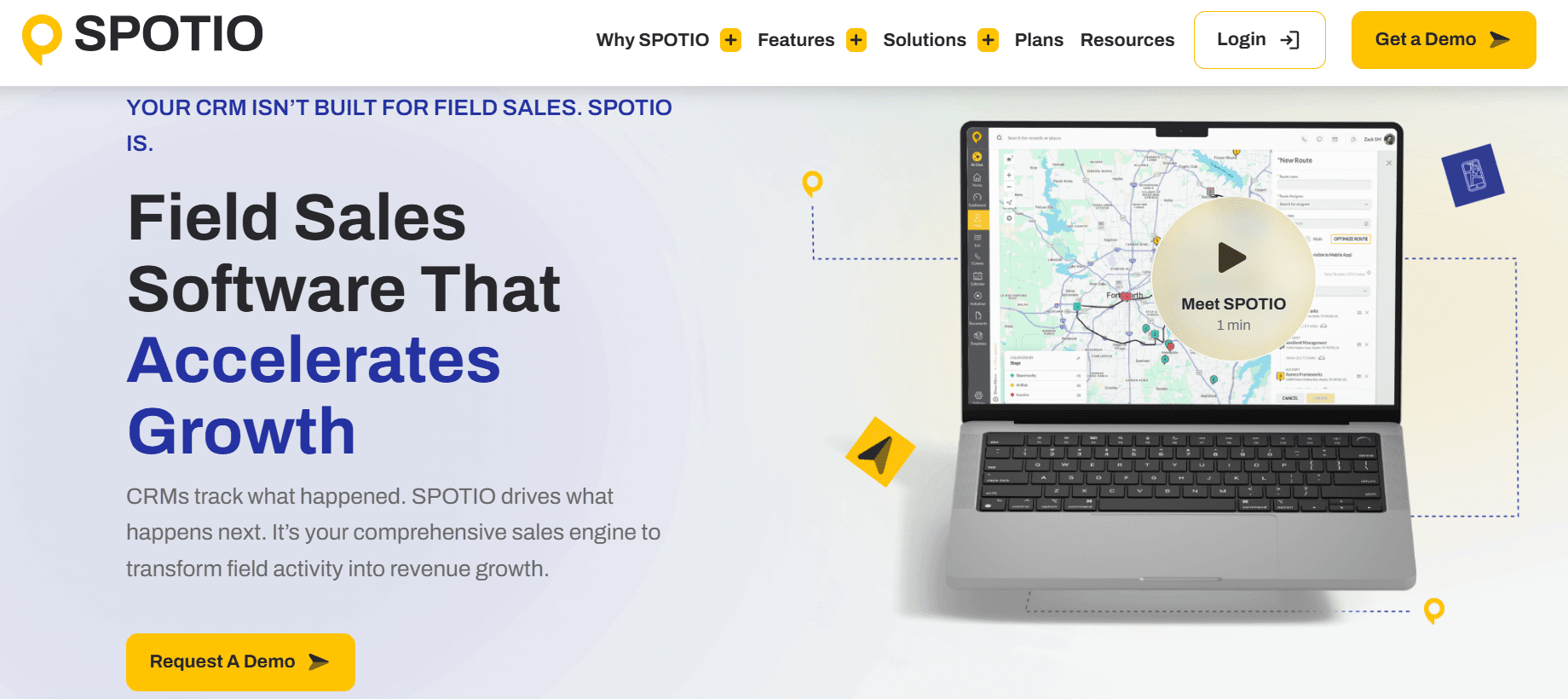
Main features: Territory management, route optimization, activity tracking, and an AI Intelligent Field Sales Assistant embedded in the app.
Key benefits: Reduces travel waste, increases rep productivity, standardizes field processes and reporting.
What Makes It Stand Out
Built specifically for door-to-door and field B2B teams, with deep location and routing tools plus an in-context AI assistant for on-the-spot answers.
3. Salesforce Einstein
Main features: Lead and opportunity scoring, activity capture, AI-driven forecasting, and prescriptive recommendations inside Salesforce.
Key benefits: Predictive prioritization tied directly to Sales Cloud records, reduced manual logging, and model-backed forecasts.
What Makes It Stand Out
Native integration with Salesforce CRM data, bringing AI where reps already work for minimal context switching.
4. HubSpot Sales Hub
Main features: AI assistants for writing and summarizing, predictive lead scoring, conversation intelligence, and workflows on HubSpot CRM.
Key benefits: Accessible AI features across free and paid tiers, and fast time-to-value for teams already in HubSpot.
What Makes It Stand Out
Breadth of integrated tools, from content generation to call analysis, inside a single CRM experience.
5. LinkedIn Sales Navigator
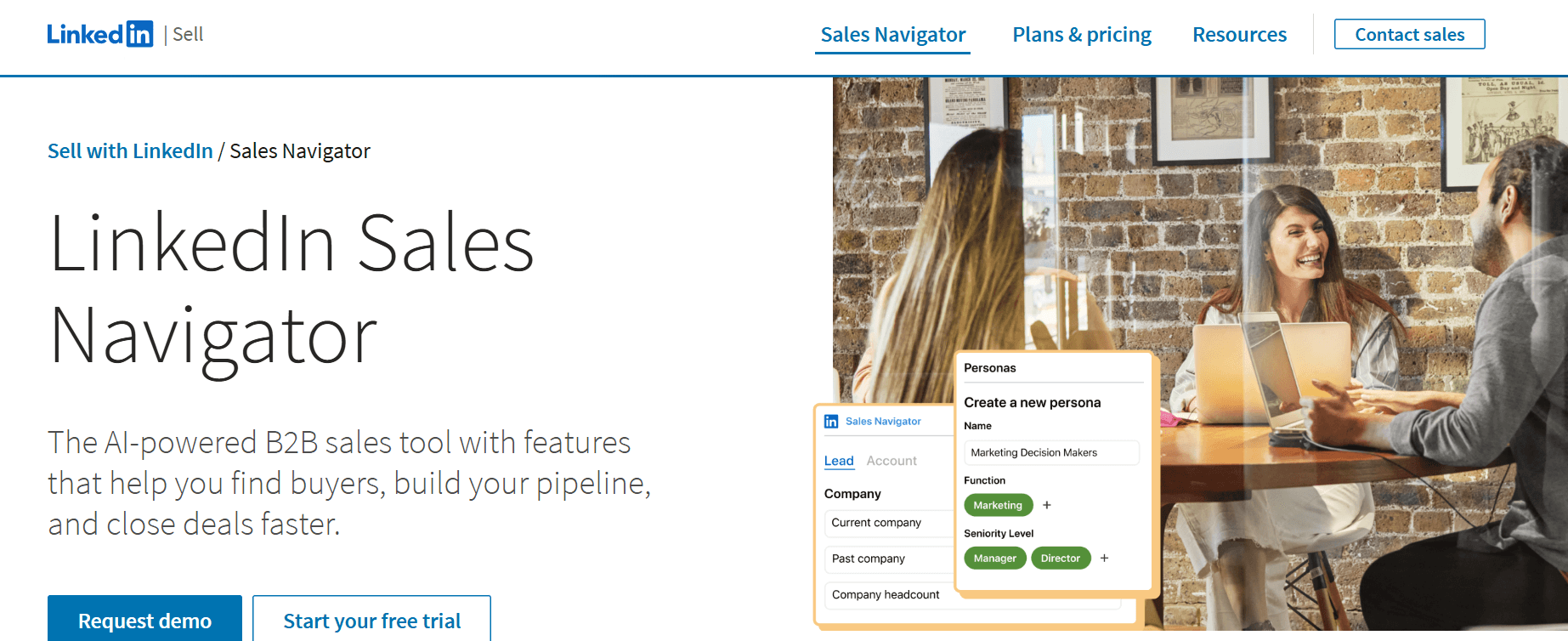
Main features: Advanced lead and account search, AI-based lead recommendations, and real-time sales updates.
Key benefits: Superior prospect discovery, context-rich profiles for personalization, and alerts that trigger timely outreach.
What Makes It Stand Out
Access to LinkedIn’s unique professional graph, ideal for social selling and warm introductions.
6. Cognism
Main features: Phone-verified contact data, GDPR/CCPA compliance, and intent enrichment.
Key benefits: Higher-quality outbound lists, reduced legal risk in EU/US outreach, and better dial outcomes.
What Makes It Stand Out
Focus on compliant mobile and international contact quality, paired with intent signals to time outreach.
7. Apollo.io
Main features: A massive B2B contact database, an AI email assistant, intelligent lead scoring, and multi-channel sequences.
Key benefits: Fast list-building, scalable automation, and integrated dialer and CRM sync.
What Makes It Stand Out
A combination of deep contact coverage with sequence automation that shortens prospecting cycles.
8. ZoomInfo
Main features: Company and contact database, buyer intent signals, technographic data, and enrichment tools.
Key benefits: Enterprise-grade prospecting, account insights for ABM, and automatic CRM data refresh.
What Makes It Stand Out
A comprehensive dataset, plus intent and technographic signals, is helpful for mid-market and enterprise sellers.
9. Seamless.AI
Main features: Real-time contact search, LinkedIn Chrome extension, and multi-step data verification.
Key benefits: Rapid on-demand prospect discovery and a low-friction UX for reps who want quick contact pulls.
What Makes It Stand Out
Live search model rather than fixed snapshots, good for teams that need immediate results.
10. Outreach
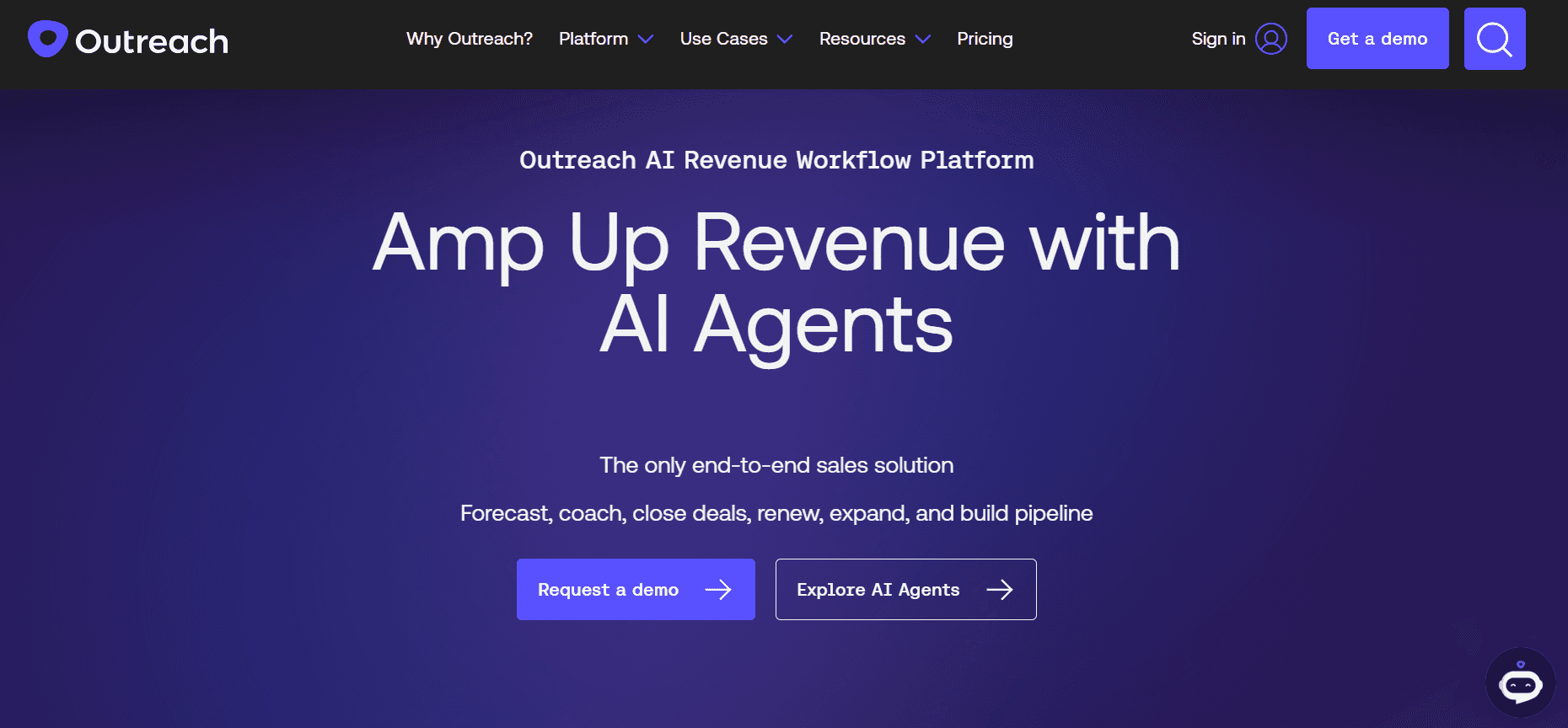
Main features: Automated multi-step sequences, Kaia real-time call coaching, and pipeline analytics.
Key benefits: Consistent, repeatable outreach playbooks and in-call nudges that improve coachability.
What Makes It Stand Out
Deep sequencing capabilities with real-time assistance that helps reps apply playbooks live.
11. Salesloft
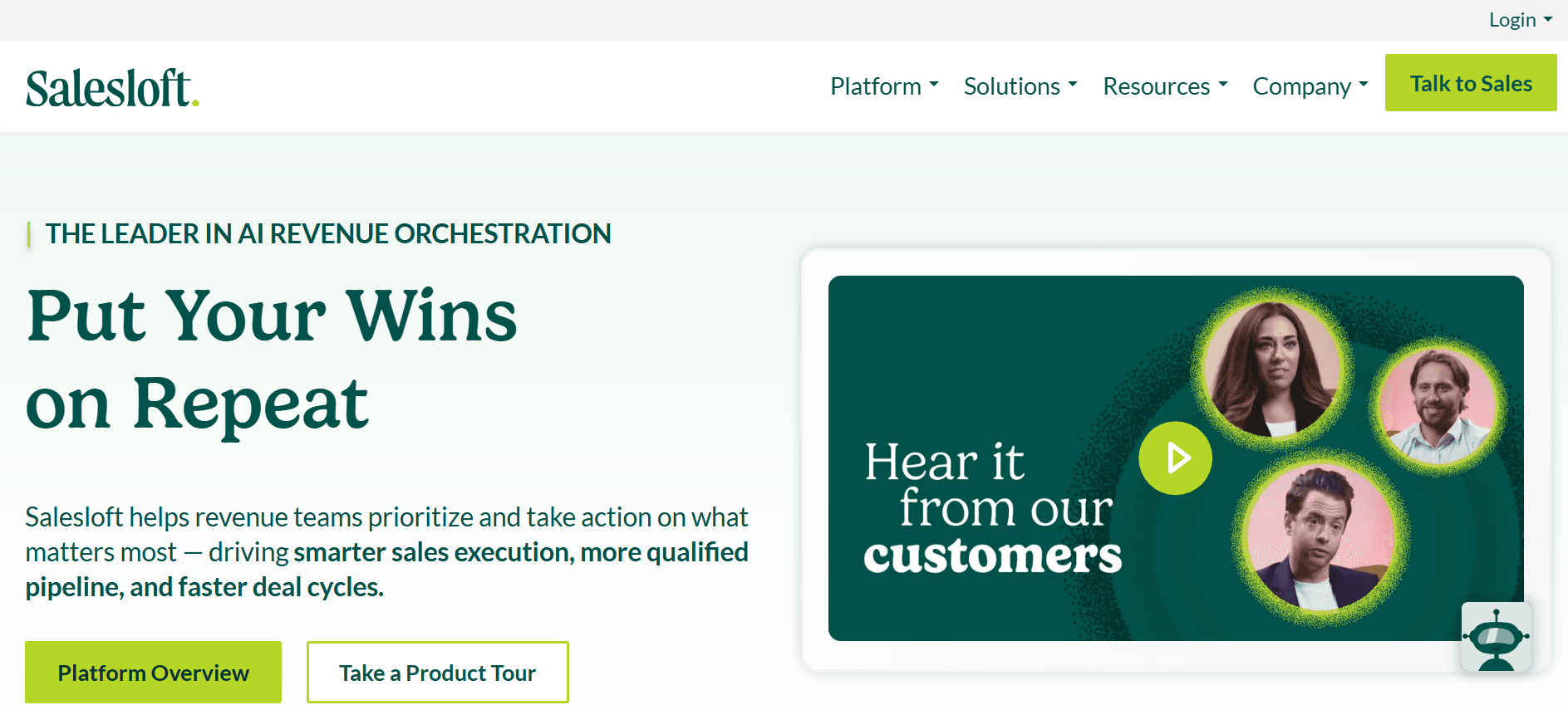
Main features: Cadence automation, conversation intelligence, and AI-driven action prioritization via Conductor.
Key benefits: Orchestrates digital selling at scale, surfaces coachable moments, and improves cadence performance.
What Makes It Stand Out
Strong enterprise feature set for full-cycle digital selling, with many integrations.
12. Seismic Content

Main features: AI content recommendations, personalization at scale, and engagement analytics.
Key benefits: helps reps find the right collateral, personalize it quickly, and measure prospect interaction.
What Makes It Stand Out
Content-first enablement that links marketing assets directly to sales outcomes.
13. Gong.io
Main features: Call capture, transcription, topic and sentiment analysis, and deal intelligence.
Key benefits: Evidence-based coaching, objective deal risk flags, and market-level conversation insights.
What Makes It Stand Out
Deep conversation analytics that turn every customer interaction into coachable signals.
14. Clari
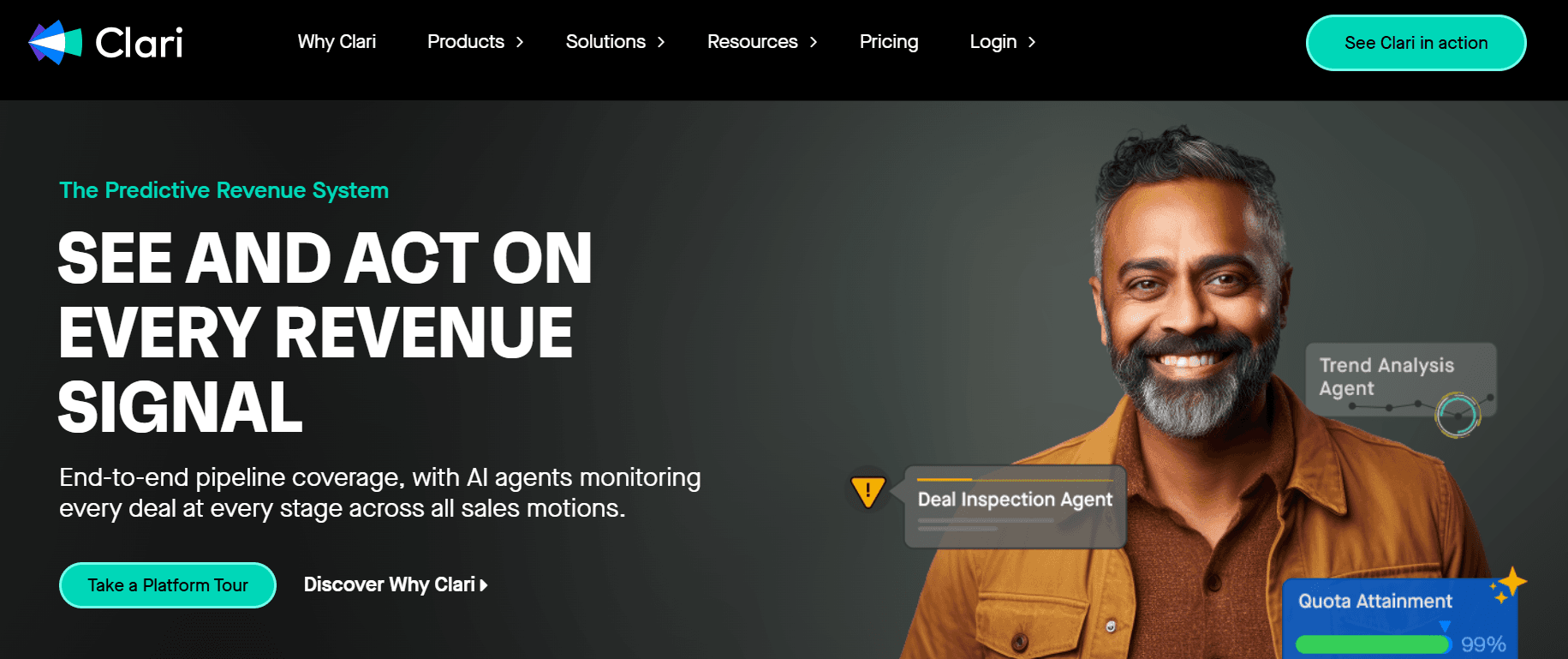
Main features: Activity capture, predictive forecasting, and pipeline inspection.
Key benefits: More reliable revenue forecasts, automated risk detection, and transparent audit trails.
What Makes It Stand Out
Purpose-built revenue operations tooling that replaces manual forecast labor with AI-backed visibility.
15. Chorus.ai
Main features: Meeting capture and analysis, moment-driven insights, and CRM sync.
Key benefits: Pinpoints critical call moments, enables targeted coaching, and enriches deal records with call context.
What Makes It Stand Out
Strong conversation intelligence with added value when combined with broader B2B datasets.
16. Lavender
Main features: Live email scoring, personalization suggestions, and team coaching dashboards.
Key benefits: Raises reply rates through tone and structure optimization, and scales best-practice email habits across a team.
What Makes It Stand Out
Focused, low-friction email improvement inside the inbox that directly affects outbound response rates.
17. Regie.ai
Main features: Generative campaign creation for sequences, social posts, and call scripts, plus a content management layer.
Key benefits: Substitutes hours of copywriting with persona-driven sequences and accelerates campaign launches.
What Makes It Stand Out
Built for go-to-market teams that need multi-touch creative at scale, not just single emails.
18. My AI Front Desk
Main features: Phone-based AI receptionist, routing automation, and chatbot integration.
Key benefits: Offloads inbound call handling, schedules appointments, and provides a virtual front desk for small teams.
What Makes It Stand Out
True conversational phone receptionist that makes decisions rather than just transcribing or routing.
19. Avoma
Main features: AI meeting assistant, live bookmarking, topic detection, and AI scorecards for meetings.
Key benefits: Faster meeting summaries, actionable coaching signals, and CRM updates tied to conversation insights.
What Makes It Stand Out
Blends post-meeting analytics with live coaching metrics that managers can act on.
20. Postaga
Main features: End-to-end outreach campaign generation, domain analysis, and sequence automation.
Key benefits: Turns content ideas into outreach flows fast, helpful for link building and promotional outreach.
What Makes It Stand Out
Campaign-first approach that combines content analysis with outreach automation.
21. Clay
Main features: LinkedIn crawling for lead lists, data enrichment, and an integrated OpenAI assistant for spreadsheet queries.
Key benefits: Quick prospect table builds, flexible enrichment workflows, and AI helpers to shape outreach.
What Makes It Stand Out
Spreadsheet-style prospect workflows with embedded AI to iterate on lists and messages.
Implementing AI-Assisted Sales
You should treat AI integration as a project with milestones, not a one-off purchase. Pick a measurable revenue or efficiency target, run a short, controlled pilot with clear guardrails, and only expand when the data proves repeatable lift. Build playbooks, measurement, and incentives around that pilot so the team sees obvious value while you keep control of risk.
What Objective Will Actually Move the Needle for My Team?
Pick one outcome that changes behavior, for example, reducing time-to-first-contact for inbound leads or increasing demo-to-close conversion for a single persona. Map one primary metric, two supporting metrics, and one guardrail metric before you start, for example:
Primary = conversion rate
Supporting = time-to-first-contact and average deal size
Guardrail = outbound reply quality
Set a minimum detectable effect and a 4-8 week test window to determine whether the lift is real, not just noise.
How Do I Pick the Right Tools Without Overbuying?
Score vendors on five non-negotiables. Real-time integration with your CRM, clear data governance and export controls, transparent decision explainability, an isolated sandbox for pilot work, and straightforward rollback procedures.
Favor pricing that lets you pilot against a single pod without long-term commitment. Require an API-first proof of concept to test reliability under real load, not a polished demo.
When Should I Run a Pilot, and What Should It Include?
Run a pilot with a single high-volume workflow, a defined control group, and a documented playbook. Log every decision the AI makes and tag human overrides so you can analyze when the model helped and when it confused reps. Use shadow mode for the first two weeks to compare recommendations against human choices, then flip to active mode once you understand baseline behavior.
Why Does Training Fail, and How Do You Fix Adoption?
Training fails when it treats AI as a feature rather than a new role. Break learning into short, role-specific modules tied to measurable outcomes, then follow up with live role-play and shadowing sessions during the first 30 days.
Appoint two AI champions, one manager, and one senior rep, to validate prompts, refine templates, and coach peers. Change incentives so adoption is rewarded through quotas or time-saved credits, not just optional badges.
What Measurement Framework Proves the AI Is Delivering Value?
Design experiments with holdout segments and run A/B tests that measure business KPIs, not model accuracy. Track conversion lift, pipeline velocity, revenue per rep, and customer acquisition cost, while logging confidence bands and decision provenance.
For CAC-focused pilots, note that Cirrus Insight reports AI-driven sales strategies can lead to a 50% reduction in customer acquisition costs, which makes clear how tightly you should link automation to acquisition KPIs. Also, plan for productivity metrics because notes sales reps using AI see a 30% increase in productivity, meaning you should measure both activity and quality to avoid perverse incentives.
What Technical and Human Failure Modes Should I Monitor?
Expect three common failures:
Signal drift when product behavior changes
Label noise from sloppy CRM entries
Metric gaming when incentives misalign
Mitigate by instrumenting data quality checks, running periodic shadow deployments, and requiring human approval for high-risk actions. Build alerts for sudden drops in precision at top K and for growth in override rates, and freeze automated actions until you diagnose the cause.
How Do I Preserve Seller Judgment While Letting AI Act?
Require transparent suggestions, not silent automation. Surface the top three reasons the model ranked a lead and allow an immediate edit before sending.
Use Confidence Thresholds
Let the AI auto-act below a low-risk threshold, suggest actions in a mid-range, and require human sign-off at high risk. Treat AI as an autopilot that handles straight runs while you keep control during turbulence.
How Do You Scale a Successful Pilot Without Breaking Things?
Standardize an automation catalog, document each playbook, and convert pilots into governed templates with version control. Add connectors incrementally, validate each in a shadow environment, then promote to production with a staged rollout and quarterly audits. Build a governance board with sales, ops, and legal to approve new agent behaviors, and lock production models behind feature flags so you can roll back instantly.
What Immediate Operational Changes Should Leaders Make?
Do an operations triage during the first month. Remove low-value manual tasks from rep lists, enforce a single source of truth for customer data, and designate an ops owner for retrain schedules and model monitoring. Commit to monthly retrain windows aligned to product release cycles, and publish a one-page incident response plan for model failures so reps know who to call when suggestions go off-track.
Related Reading
AI Sales Prospecting Tools
AI Tools For B2B Marketing
AI For Sales Calls
Lead Qualification Strategies
Get Access to our AI Growth Consultant Agent for Free Today
If you want to build and scale an AI-powered business without the complexity or the need for massive teams, consider AI Acquisition, used by more than 1,200 entrepreneurs to automate lead generation, sales, and operations, with clients averaging $18,105 in monthly revenue and collectively generating over $30 million this year.
Get access to a free AI Growth Consultant today and see how a digital workforce of AI agents can work 24/7 to fill your pipeline, book meetings, and deliver human-quality results while you focus on growth, not guesswork.